Why Flip Turns Feel Impossible Long After You've Learned the Freestyle Stroke
Quick Answer: Flip turns feel harder than the stroke itself because they combine three separate skills — breath-holding, spatial disorientation, and timed wall contact — under time pressure, and adult swimmers rarely drill them in isolation the way kids in swim team do.
You can hold a stroke for 500 meters without much thought. Then you reach the wall, hesitate, do an awkward open turn, and wonder why the one skill everyone else seems to have just clicked for is still nowhere close for you.

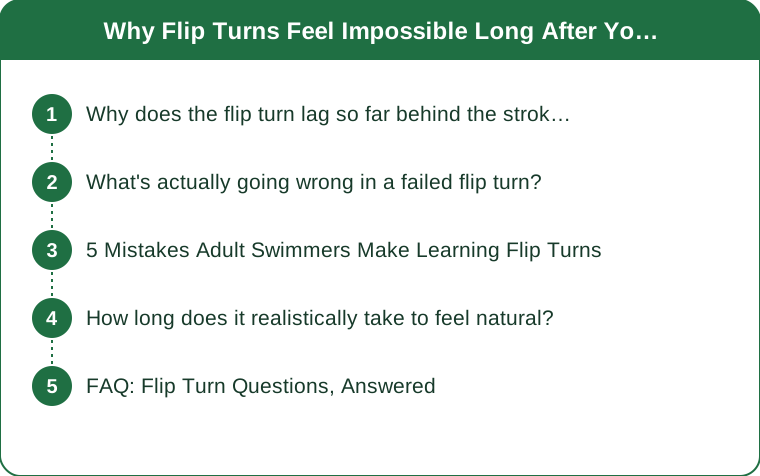
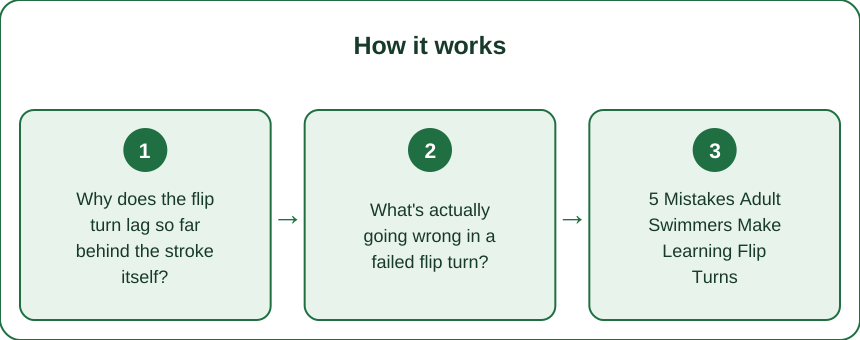
Why does the flip turn lag so far behind the stroke itself?
Freestyle is a repetitive, forward-facing pattern your body adapts to quickly. A flip turn asks you to tuck, invert, and reorient underwater in about a second, all while holding your breath — it’s a completely different motor skill wearing the same swimsuit.
Most adult learners never drill the turn on its own. They just attempt it mid-lap, under fatigue, which stacks a new skill on top of an already-tired body.
What’s actually going wrong in a failed flip turn?
Usually one of three things: tucking too late (hitting the wall with straight legs), misjudging distance so the feet land short or overshoot, or holding the breath wrong, leading to a panicked half-turn. Any one of these throws off the whole sequence.
Distance judgment is the most common culprit — most beginners either dive under too early or reach the wall with no room to tuck at all.

5 Mistakes Adult Swimmers Make Learning Flip Turns
1. Practicing full-speed before slowing down to isolate the tuck.
2. Skipping wall-only drills — pushing off from a stationary tuck without ever swimming into it.
3. Not counting strokes to the wall, so distance stays a guess every time.
4. Holding a full breath instead of a controlled exhale, which makes the tuck feel more panicked than it needs to be.
5. Giving up after a few tries in one session instead of spacing practice across several short sessions.
How long does it realistically take to feel natural?
Most adult learners need 2-4 weeks of dedicated short drills — 10 minutes per session, not full sets — before the tuck starts feeling automatic. Learning it embedded in normal lap swimming takes much longer, since fatigue keeps sabotaging the form.
Counting your stroke count into the wall from a consistent starting point speeds this up significantly.
FAQ: Flip Turn Questions, Answered
Is it normal to swallow water the first several tries?
Yes — that’s almost universal early on and usually resolves once the exhale timing during the tuck becomes more controlled.
Should I learn flip turns before or after my stroke feels solid?
After — a shaky stroke under the added complexity of a turn just compounds frustration. Get the stroke comfortable first.
Do goggles fogging up make flip turns harder to learn?
Indirectly, yes — losing sight of the wall right before the tuck throws off timing, so solving fog issues first removes one variable.
TL;DR:
- Flip turns lag behind stroke skill because they stack three new skills under time pressure
- Distance misjudgment is the most common cause of a failed turn
- Isolate the tuck with short wall drills instead of practicing at full lap speed
- Expect 2-4 weeks of short, dedicated sessions before it feels natural
The wall isn’t testing your swimming — it’s testing a completely separate skill that just happens to live at the end of your lap.
Keep Reading
This article is for general informational purposes only and is not medical advice. Always consult a qualified health professional for guidance specific to you.