Why Adult Swim Lessons Go Better in September Than in January
Quick Answer: September starts work better than January starts for adult swimmers for four practical reasons: pools are quieter and lesson slots are more available before the New Year rush, the term structure gives you a defined block with an end point, you get a run of consistent weeks before the winter disruption of illness and holidays, and the motivation is usually intrinsic rather than resolution-driven. The single biggest predictor of learning to swim as an adult is uninterrupted consistency across eight to twelve weeks, and autumn provides that better than winter does.
You have been saying you will learn to swim properly since about 2019.
Every January you look it up, every February the pool is full, and every March you stop.

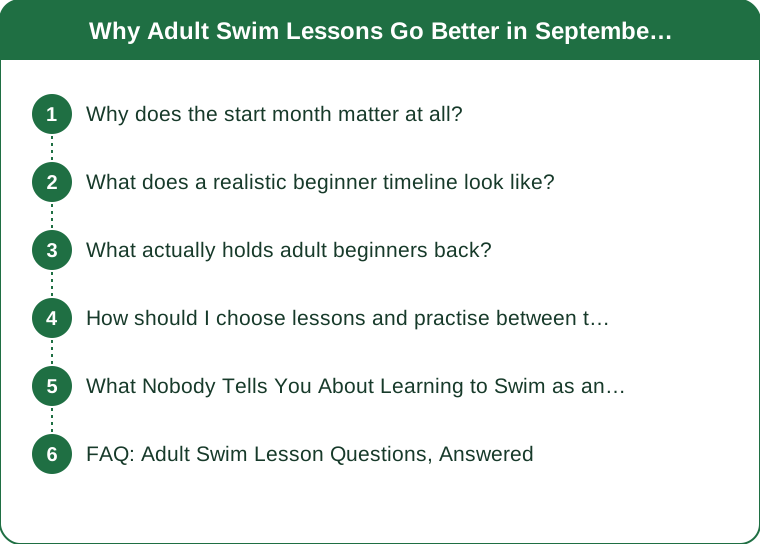
Why does the start month matter at all?
Because swimming is a skill acquisition problem, and skill acquisition needs unbroken frequency. A gap of two or three weeks in the early phase costs disproportionately more than the same gap later.
January starts run into February half term, illness season and pool closures, which produces exactly the interruptions that stall early progress.
September gives you a clean run to Christmas, which is roughly fourteen weeks and comfortably enough for a beginner to become functional.
Lesson availability is genuinely better in September, since the New Year surge has not arrived and adult classes are less oversubscribed.
Pools are quieter for practice between lessons, which is where most of the progress actually happens.
And the psychological framing is different. A September start is a decision; a January start is a resolution, and resolutions carry an expectation of failure that decisions do not.
What does a realistic beginner timeline look like?
Weeks one to three: water comfort and breathing. Being relaxed with your face in the water and exhaling underwater is the actual foundation, and rushing it is the most common cause of a stalled adult swimmer.
Weeks four to six: floating and basic propulsion, typically starting with kicking and body position rather than arms.
Weeks seven to ten: putting a stroke together, which usually means backstroke or front crawl depending on the teacher’s approach - and backstroke first is a legitimate and often effective route because breathing is not a constraint.
Weeks ten to fourteen: continuous swimming over a length, which is the point most adults describe as being able to swim.
Practice between lessons roughly doubles the rate of progress, even if the practice is just twenty minutes of the previous week’s drill.
And the timeline varies widely. Adults with water anxiety may spend six weeks on comfort alone, which is not slow progress - it is the necessary part being done properly.
What actually holds adult beginners back?
Breathing, almost universally. Holding the breath rather than exhaling underwater is the single most common technical fault and it makes everything else harder.
Body position, which follows from breathing. A held breath and a lifted head sink the legs, and sinking legs make propulsion enormously harder.
Tension. A tense body is a dense body in the water, and relaxation is a technical skill rather than an attitude.
Embarrassment, which is a real barrier and is why adult-only lessons matter so much. Being the only adult in a pool of children is a genuine deterrent.
Inconsistency, which is the biggest one and the reason start month matters at all.
And trying to swim rather than trying to float. Almost every adult beginner works too hard, and the breakthrough is usually doing less rather than more.

How should I choose lessons and practise between them?
Choose adult-only lessons if they are available, which changes the experience substantially and is worth travelling further for.
Small groups or one-to-one for the first block, since the water comfort phase benefits enormously from individual attention.
Ask about the teacher’s experience with anxious adult beginners specifically, because it is a distinct skill from teaching children.
Book a block rather than paying weekly, which materially improves attendance for most people.
Practise the exact drill from the lesson rather than trying to swim, which is the most common way practice sessions get wasted.
Twenty minutes twice a week between lessons is plenty, and consistency matters far more than duration at this stage.
What Nobody Tells You About Learning to Swim as an Adult
Adults learn the technical parts faster than children and the comfort parts slower. You can understand and apply a body position cue immediately; what takes time is the nervous system accepting that having your face in water is fine. Nobody explains this, so adults conclude they are slow learners.
Exhaling underwater is the whole game for the first month. Almost every adult beginner holds their breath, which raises tension, sinks the legs and shortens every attempt. Teachers spend weeks on it because it genuinely is that important.
Backstroke first is often faster than front crawl first. With your face out of the water, the breathing problem disappears and you can learn body position and propulsion without the hardest element attached. Many good teachers do this deliberately.
Goggles that leak will end your progress faster than any technical problem. An enormous number of adult beginners struggle with equipment that does not fit and assume the discomfort is inherent to swimming. Spend the extra on goggles that seal.
Progress is not linear and the plateau at week six is normal. Almost everyone hits a point where nothing improves for two or three weeks, and it is nearly always immediately before a jump. Quitting at week six is the most common failure point.
And nobody in the pool is watching you. This is the single most common anxiety among adult beginners and the least justified - lane swimmers are counting their lengths and thinking about their own stroke. This is general information, not medical advice.
FAQ: Adult Swim Lesson Questions, Answered
How long does it take an adult to learn to swim?
Commonly eight to fourteen weeks of consistent weekly lessons to swim a length comfortably, with wide variation depending on water comfort at the start.
Am I too old to learn?
No. Adults learn to swim at every age, and the main variables are consistency and finding a teacher experienced with adult beginners rather than age itself.
Should I have one-to-one or group lessons?
One-to-one or small groups are generally better for the first block, particularly if you have any anxiety in water. Larger groups work well once basic comfort is established.
What if I am frightened of water?
That is common and teachable. Look specifically for a teacher who advertises experience with anxious adult beginners, and expect the first weeks to focus entirely on comfort rather than strokes.
How often should I go?
One lesson plus one or two short practice sessions a week produces markedly faster progress than a lesson alone. Consistency matters more than session length.
Which stroke should I learn first?
Many teachers start with backstroke because breathing is not a constraint, which lets you develop body position and propulsion first. Follow your teacher’s approach.
What kit do I actually need?
Well-fitting goggles that do not leak, a comfortable swimsuit and a cap if you have long hair. Goggles are the item worth spending on. This is general information, not medical advice.
TL;DR:
- September starts beat January starts because they give an uninterrupted run of consistent weeks.
- Lesson availability and pool quietness are both better before the New Year surge.
- Exhaling underwater is the foundation - held breath sinks the legs and makes everything harder.
- Backstroke first is often faster, since it removes the breathing constraint while you learn body position.
- Practise the lesson’s drill rather than trying to swim, twenty minutes twice a week.
- The week six plateau is normal and comes immediately before a jump.
Start in September and you will be swimming by Christmas. This is general information, not medical advice.
Keep Reading
This article is for general informational purposes only and is not medical advice. Always consult a qualified health professional for guidance specific to you.