Adult Swim Lessons: Why Kicking From the Knee Instead of the Hip Slows You Down
Quick Answer: Kicking from the knee (a bicycle-style kick) creates drag and wastes energy because bent knees push water forward instead of back, while kicking from the hip with mostly straight legs and a small, fast flutter generates real propulsion — the habit usually comes from land-based movement patterns that don’t translate to swimming.
Your instructor calls out ‘kick from the hip’ for the third time this lesson, and you genuinely feel like you are — but your legs keep bending noticeably at the knee, and you’re gassed after two laps with barely any forward movement to show for it.
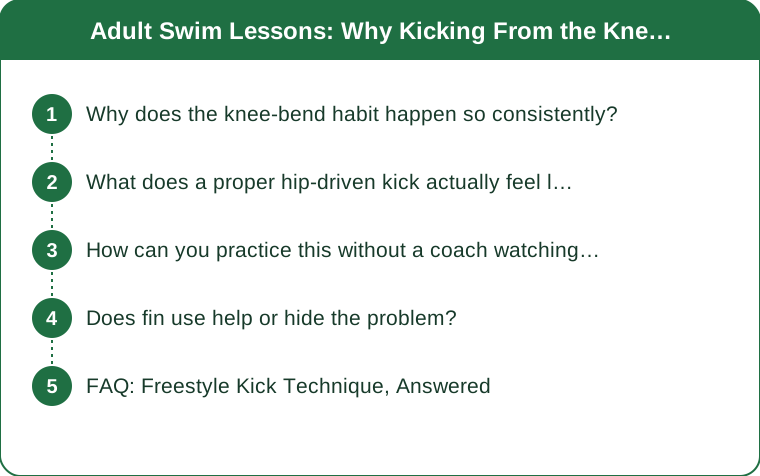
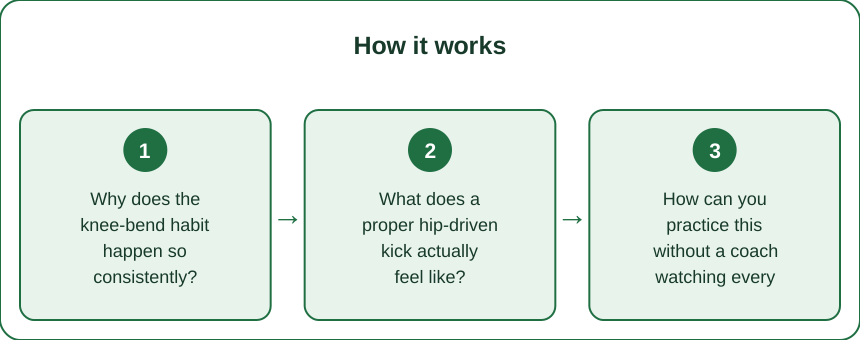
Why does the knee-bend habit happen so consistently?
On land, almost every movement that propels you forward — walking, running, cycling — bends significantly at the knee. Your body defaults to that familiar pattern in the water because it’s the movement your brain associates with ‘moving your legs to go forward.’
But water resistance works differently than ground reaction force. A bent knee pushes water mostly forward and sideways rather than backward, which is the opposite of what actually propels you.
What does a proper hip-driven kick actually feel like?
The movement originates from your hip flexors and glutes, with your legs staying close to straight and your knees bending only slightly and passively at the bottom of each kick — not as the driver of the motion. It should feel like a small, quick flutter rather than a large, effortful pedal.
Many adult swimmers describe the correct feeling as ‘kicking from your core’ rather than your legs at all, since the power genuinely originates higher up the body than it feels like it should.

How can you practice this without a coach watching every rep?
Kickboard drills with a pool noodle held between your thighs force straighter legs, since bending significantly at the knee makes the noodle slip. Vertical kicking in deep water (treading with a flutter kick only, no hands) also exposes a knee-driven kick quickly, since it becomes noticeably inefficient and tiring within seconds.
Does fin use help or hide the problem?
It can go either way. Short training fins exaggerate the payoff of a proper hip-driven kick, which helps some swimmers feel the correct motion for the first time. But fins also let a knee-bent kick ‘work’ well enough that you don’t notice the inefficiency — use them for a few sessions to build feel, then swim without them regularly to confirm the habit has actually changed.
FAQ: Freestyle Kick Technique, Answered
How many kicks per arm stroke should adult beginners aim for?
A 2-beat or 6-beat kick pattern both work depending on your stroke rhythm — consistency matters more than hitting an exact number as a beginner.
Is ankle flexibility part of this problem too?
Yes — stiff ankles often force more knee bend to compensate, so ankle mobility drills (pointing and flexing, sitting on your heels) can support the fix alongside conscious kick technique.
Should I focus on kick technique before or after breathing technique?
Most instructors address breathing first since it affects safety and comfort more directly — kick technique refinement usually comes once breathing feels reasonably automatic.
TL;DR:
- Bending at the knee is a land-movement habit that creates drag instead of propulsion in water
- A proper kick starts at the hip with mostly straight legs and a small, fast flutter
- Kickboard drills with a noodle between the thighs and vertical kicking both expose a knee-driven kick quickly
- Fins can help you feel the correct motion but can also mask an unfixed habit
The fix isn’t kicking harder — it’s kicking from a different, higher place than land movement ever taught your body to use.
Keep Reading
This article is for general informational purposes only and is not medical advice. Always consult a qualified health professional for guidance specific to you.