Why Treading Water Exhausts Adult Beginners Way Faster Than It Should
Quick Answer: Treading water exhausts adult beginners fast because most default to an inefficient, high-effort kick (a fast, shallow flutter or frantic scissor motion) instead of the slower, more efficient eggbeater or breaststroke-style kick that experienced swimmers rely on — technique, not fitness level, is usually the real gap.
It’s a strange, deflating moment: you’ve made real progress with strokes, but treading water in place still wipes you out in under a minute. The good news is this specific gap has a specific, learnable fix.

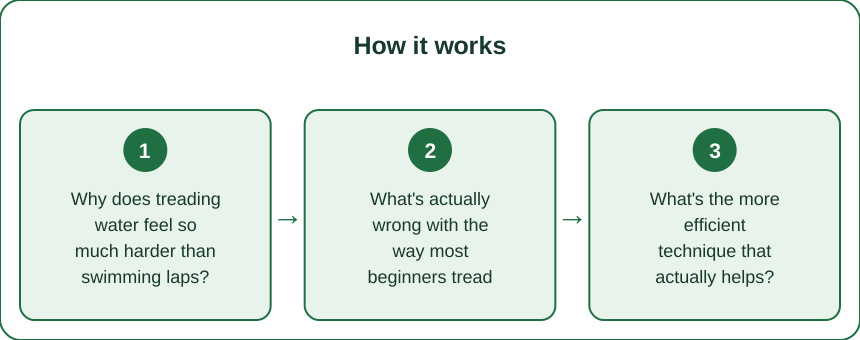
Why does treading water feel so much harder than swimming laps?
Swimming laps lets you use forward momentum and glide phases to rest between strokes, even briefly. Treading water offers no momentum or glide at all — every bit of effort goes directly into staying vertical and afloat, with zero recovery phase, which is why it burns through energy so much faster than the same rough intensity of lap swimming.
What’s actually wrong with the way most beginners tread water?
Most self-taught adult beginners default to a fast, shallow flutter kick or an exaggerated scissor kick, both of which are high-effort, low-efficiency movements borrowed from swimming strokes that weren’t designed for staying vertical in place. These kicks work, but burn far more energy per minute of support than a proper treading technique.
What’s the more efficient technique that actually helps?
The eggbeater kick — alternating circular leg motions, one leg at a time, similar to pedaling a bike sideways — is significantly more energy-efficient for sustained vertical support than a flutter or scissor kick, and it’s the technique competitive water polo and synchronized swimming rely on for exactly this reason. A simpler breaststroke-style kick (both legs moving together in a circular whip motion) is an easier entry point for most adult beginners before progressing to eggbeater, and still offers real efficiency gains over a flutter kick.
Myth vs Fact: Treading Water
Myth: “Treading water is mostly a leg strength issue.” Fact: it’s primarily a technique and efficiency issue — many strong swimmers with underdeveloped treading technique still fatigue fast, while smaller-framed swimmers with good technique can sustain it far longer.
Myth: “Using your arms more helps you tread longer.” Fact: arms should do sculling (small figure-eight motions at the surface) for stability, not large paddling motions — big arm movements burn energy fast without adding proportional support.
Myth: “You need to keep your whole head well above water the entire time.” Fact: relaxing so only your face stays clear, rather than your whole head and shoulders, reduces the amount of support your legs need to generate, which meaningfully extends how long you can sustain it.
Does body position affect treading efficiency too?
Yes, substantially. A more upright, relaxed vertical posture, rather than fighting to stay high out of the water, requires less kicking effort overall. Tensing the whole body and trying to stay high reduces natural buoyancy efficiency — a relaxed body actually floats better than a rigid, tense one, which then means less kick effort is needed to maintain position.
FAQ: Treading Water for Adult Beginners, Answered
How long should a beginner realistically be able to tread water?
One to two minutes is a reasonable early goal with improving technique — competitive athletes can sustain it for much longer, but that’s not the relevant comparison for a beginner building basic water safety competence.
Is eggbeater kick hard to learn as an adult?
It takes practice but is learnable at any age — starting with a breaststroke-style kick and progressing to eggbeater over several lessons is a realistic, low-frustration path.
Does treading water get easier with general swim fitness, or only with treading-specific practice?
Both help, but treading-specific practice matters more — general swim fitness improves the fuel tank, but inefficient technique still drains it fast regardless of overall fitness level.
TL;DR:
- Treading water is exhausting mainly because of technique, not fitness — there’s no glide phase to rest during
- A flutter or scissor kick burns far more energy than an eggbeater or breaststroke-style kick
- Sculling arms and a relaxed, upright posture both reduce how hard your legs have to work
- One to two minutes is a realistic early goal — competitive-level endurance isn’t the right comparison
The gap between swimming laps confidently and dreading treading water usually closes with a specific technique fix, not more general fitness.
Keep Reading
This article is for general informational purposes only and is not medical advice. Always consult a qualified health professional for guidance specific to you.