Why You Swim Better in Lessons Than You Do on Your Own
Quick Answer: In a lesson you get external pacing, immediate correction, short repeats with rest, and someone else deciding what happens next. On your own you default to swimming continuously at a pace you choose, which is almost always slightly too fast, with no feedback and no structure. The gap is not skill; it is that you are doing a different activity. Bring the lesson structure with you — short repeats, defined rest, one focus point — and the gap closes quickly.
This is one of the most common frustrations in adult swimming, and it is entirely fixable.
We have covered why adult swimmers plateau around week six, why your second length falls apart when the first was fine, and the water confidence that comes before stroke work. This one is about practising alone.
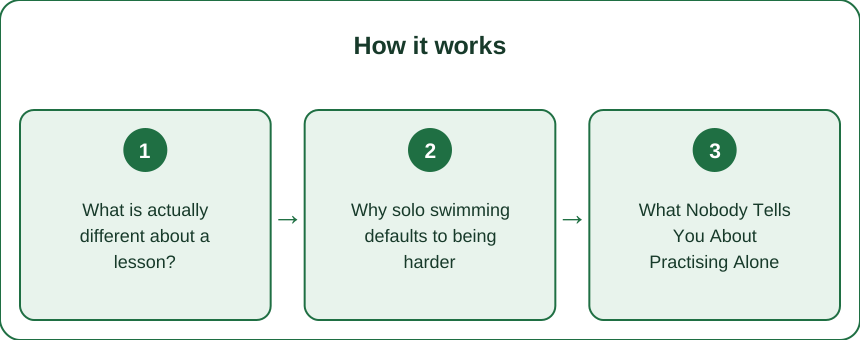
What is actually different about a lesson?
Six things, and none of them are about the instructor watching you.
The set is decided for you. You are told to swim four lengths, rest, and repeat. Left to yourself, almost everyone swims continuously until they are too tired to continue.
Rest is built in. Lessons naturally include explanation time, which functions as structured recovery. Alone, people rest only when they have to, which is far too late.
You have one thing to think about. A good lesson gives you a single focus — exhale continuously, reach further, look down. Alone, most people think about everything at once and therefore about nothing.
Someone corrects you within seconds. Errors do not have time to embed. On your own, you can reinforce a fault for twenty lengths without knowing.
The pace is externally set. Being told when to push off removes the unconscious speed creep that makes solo swimming so much harder than it needs to be.
And you are less self-conscious than you expect. In a lane with a coach you have permission to be a learner. In a public lane you feel watched, and tension in the neck and shoulders directly degrades body position.
Why solo swimming defaults to being harder
Left to your own devices, everything drifts in the same direction.
Pace creeps up. Without external timing, most swimmers settle slightly above their sustainable effort within the first two lengths, then fight it for the rest of the session.
Breathing rhythm shortens under that pace, and short breathing raises tension, which drops the hips and raises the effort further.
Continuous swimming hides technique. Once you are breathless, form collapses, and you spend most of the session practising your worst stroke rather than your best one.
There is no reset. In a lesson, every rest interval lets you start the next repeat with good technique. Continuous swimming means every length starts from the state the previous one ended in.
Tiredness gets interpreted as lack of fitness. It is usually lack of structure, and the fix is a pace clock rather than more sessions.
And there is no feedback loop at all. You cannot see yourself swim, and water muffles most of the sensations you would otherwise use to self-correct.
What Nobody Tells You About Practising Alone
The pace clock is the coach. Every pool has one, almost no adult swimmer uses it, and it replaces about half of what a lesson provides. Push off on a set interval and rest is defined for you rather than negotiated with yourself.
Short repeats beat long swims for technique. Four lengths of twenty-five with fifteen seconds rest teaches you far more than one continuous hundred, because all four are swum with good form.
One focus point per session, not five. Pick exhaling continuously, and let everything else be whatever it is. Trying to fix three things at once reliably fixes none.
Recording yourself is startlingly effective. Ask a friend for thirty seconds of video from the side of the pool. Almost everyone is surprised, and almost everyone fixes something immediately.
Counting strokes per length is the cheapest feedback available. If it goes up as you tire, your stroke is shortening. If it stays even, your technique is holding. It costs nothing and tells you more than a stopwatch.
And the empty lane is worth planning for. Sessions at quiet times are not a luxury; sharing a lane forces pacing that has nothing to do with your own technique.
A solo session that works like a lesson
Thirty to forty minutes, structured the way a class would be.
Warm up for four to six lengths easy, with no focus other than breathing out underwater.
Pick one technique point and say it out loud before you start. Naming it makes it far more likely to survive the first length.
Do short repeats with defined rest. Four times twenty-five metres with fifteen seconds rest, or four times fifty with thirty. Push off on the clock, not when you feel ready.
Count your strokes on every repeat and write the number on your hand if you need to. Rising counts mean stop and rest longer.
Include one drill block. Six lengths of side kicking or single-arm freestyle in the middle of the session, where you are warm but not yet tired.
Finish with two to four easy lengths with no focus at all, which consolidates far better than stopping at exhaustion.
And keep a two-line note afterwards. What you worked on, and your stroke count. Three sessions of that will tell you more about your progress than a month of swimming without it.
FAQ: Solo Swim Practice Questions, Answered
Why do I swim worse on my own than in a lesson?
Because you are doing a different activity. Lessons provide structure, defined rest, external pacing and a single focus. Alone, most swimmers default to continuous swimming slightly too fast with nothing to correct them.
How should I structure a solo swim session?
Short repeats with fixed rest, one technique focus for the whole session, one drill block in the middle, and an easy finish. Use the pace clock to set your intervals rather than resting by feel.
How do I know if my technique is holding up?
Count your strokes per length. A rising count as the session goes on means your stroke is shortening under fatigue, which is the signal to rest longer or end the set — not to push through.
TL;DR:
- Lessons give you structure, rest, pacing and a single focus. Solo swimming gives you none of those by default.
- Use the pace clock. It replaces roughly half of what a coach provides, and every pool already has one.
- Short repeats with defined rest let you practise good technique instead of rehearsing your tired stroke.
- Count strokes per length. A rising count is the clearest feedback available without a coach.
The skill transferred perfectly well. The structure did not, and structure is the part you can bring with you.
Keep Reading
This article is for general informational purposes only and is not medical advice. Always consult a qualified health professional for guidance specific to you.