Why You Can Swim One Length but Not Two
Quick Answer: Almost always it is a breathing problem, not an endurance problem. Most adult beginners hold their breath through the first length without noticing, arrive at the wall with a CO2 debt they cannot clear in one gasp, and start the second length already behind. The fix is continuous exhalation into the water and a slower, deliberate first length — not more fitness.
The first length feels manageable. Not easy, but fine.
Then you turn, push off, and by the halfway mark your chest is tight, your legs have dropped, and you are standing up. The consistency of it is the giveaway — a genuine fitness ceiling does not land in the same spot every time. Something structural is happening on that first length, and it comes due on the second. The third section names it.

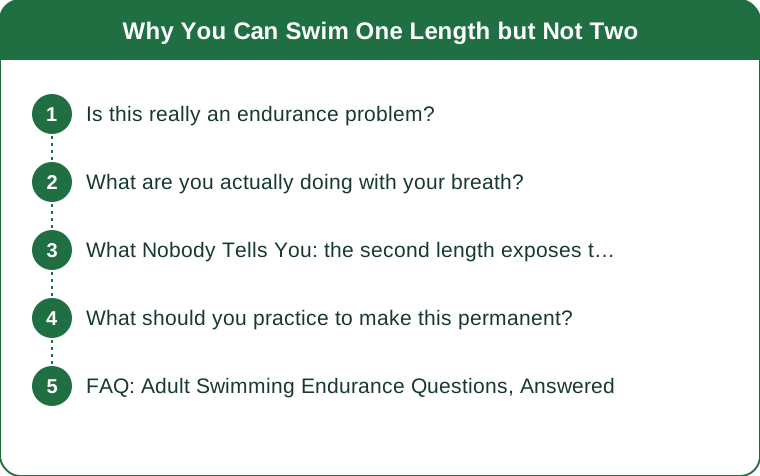
Is this really an endurance problem?
Look at the evidence, because it argues clearly against fitness.
You can probably walk briskly for forty-five minutes. One length of a pool takes under a minute. If your aerobic system could not handle sixty seconds of moderate work, you would notice it everywhere in your life, not just in the water.
The wall is always in the same place. True aerobic limits arrive gradually and move around depending on how you slept and what you ate. A ceiling that lands at the same point every single time is mechanical.
You recover in about thirty seconds at the wall. Genuine aerobic exhaustion takes minutes to clear. Thirty seconds is exactly how long it takes to clear a CO2 backlog and re-establish a breathing rhythm.
So what is happening is this: you are accumulating an oxygen and CO2 debt through length one that you cannot clear in the couple of seconds you spend at the wall. You start the second length in deficit, and the deficit compounds because the same faulty breathing is still running.
The good news in that diagnosis is that the fix is a skill, and skills change quickly. You are not weeks of training away from this. You are one adjustment away.
What are you actually doing with your breath?
Three specific errors, usually all at once, and none of them are visible to you while they are happening.
You hold your breath with your face in the water. This is nearly universal in adult beginners, and it comes from a completely sensible instinct — face in water, close everything. But holding your breath means CO2 accumulates in your blood, and rising CO2 is what creates the urgent, panicky need to breathe. It is not lack of oxygen that makes you desperate. It is CO2 you have not let go of.
You try to exhale and inhale in the same brief window. When you finally turn to breathe, you have to blow out a full breath and then pull a new one in, all in the fraction of a second your mouth clears the water. There is not enough time. So you get a partial inhale, turn your face back down, and the debt grows.
You inhale too big, too fast. Overcompensating with a huge gulp adds air to lungs you never emptied, which increases the feeling of tightness and makes you more buoyant in the chest — which drops your legs.
The correction is one sentence: exhale slowly and continuously the entire time your face is in the water, so that when you turn to breathe, all you have to do is inhale.
It feels wrong at first. Emptying your lungs in the water feels like giving away your safety margin. It is the opposite — a slow steady exhale is what keeps CO2 from building, and it converts the breath into a single simple action instead of two rushed ones.

What Nobody Tells You: the second length exposes the first length
Here is the part that reframes the whole problem.
Whatever you did wrong on length one does not cost you until length two. You have enough reserve to absorb one length of inefficiency. You do not have enough for two.
Which means the diagnostic question is not what went wrong on the second length. It is what you did on the first.
Almost always it is this: you went too hard. The first length feels like the start of something, so you push off hard, take fast strokes, and cover it quickly. It feels fine because it is short. But you built the CO2 debt at a rate you can only sustain for about that long.
Try this, and it is the single most useful experiment in this article. Swim the first length deliberately slowly. Slower than feels productive. Long, unhurried strokes, a soft kick, exhaling steadily the entire time your face is down. Take a full breath at the wall. Then swim the second length the same way.
Most people who do this get to the second wall for the first time on the first attempt. Not because they got fitter in five minutes — because they stopped spending their reserve in the first thirty seconds.
The secondary effect matters too. When you swim slower, your stroke is better: your catch has time to set, your body stays flatter, your legs stay up. Speed hides in efficiency, and effort destroys it. The slow length is not a compromise version. It is the version that works.
What should you practice to make this permanent?
Four drills, in order, none of which require you to be fit.
1. Bubble breathing at the wall. Hold the gutter, face in the water, exhale slowly through your nose and mouth for a count of three or four, lift and inhale. Twenty repetitions. You are teaching your body that exhaling underwater is safe and unhurried. This sounds too basic to matter. It is the foundation of everything else.
2. Kick with a board, breathing on a rhythm. Face in the water, exhaling, lift to breathe on a set count. This isolates the breathing pattern from the complexity of the stroke.
3. Six-stroke swims. Push off, take six strokes with proper breathing, stand up. Rest. Repeat ten times. You are practicing the pattern, not the distance. Short repeats with good form beat long repeats with collapsing form every time.
4. Build by adding, not by grinding. Once two lengths are comfortable, do three. Then four. Add one length a week. Resist the urge to test your maximum — testing your maximum rehearses the collapse.
One structural note on rest: at the wall, take three full breaths before pushing off, not one. Adult beginners consistently rush the turn because it feels like cheating to stand there. It is not. The rest interval is part of the training, and a proper one lets you swim the next length with the technique you are trying to build rather than the panicked version.
Expect it to feel worse before it feels better for a session or two, because you are overwriting a habit. By the third session, most people notice the difference clearly.
FAQ: Adult Swimming Endurance Questions, Answered
How long before I can swim continuously for 20 minutes?
If breathing is your limiter, faster than you think — many adults get from two lengths to continuous swimming within a few weeks of consistent practice, because the constraint was never aerobic. Progress tends to be steplike rather than gradual.
Should I breathe every stroke if that helps?
Yes, if it keeps you swimming. Breathing every two strokes on one side is fine as a starting point. The purity of bilateral breathing matters far less than staying relaxed and finishing the length. Add the pattern work later.
Does it help to swim with fins while learning this?
Yes, quite a lot. Fins hold your legs up and let you focus entirely on the breathing pattern without also fighting body position. Use them for drills, not for every swim, so you do not become dependent on the lift they provide.
TL;DR:
- The one-length ceiling is a breathing problem, not a fitness one — the giveaway is that it lands in the same place every time.
- Holding your breath builds CO2, and CO2 is what creates the panic, not a lack of oxygen.
- Exhale slowly and continuously with your face down, so breathing becomes one action instead of two.
- Swim the first length deliberately slowly; the second length is where the first length’s cost comes due.
- Practice short repeats with good form, take three breaths at the wall, and add one length a week.
There is something genuinely unfair about learning to swim as an adult — every other endurance activity rewards you for trying harder, and this one punishes you for it. The reflex to push through, which serves you everywhere else, is exactly the thing standing between you and the far wall. Go slower than feels reasonable, let the air out the whole time your face is down, and give it three sessions. The second length is much closer than it feels right now.
Keep Reading
This article is for general informational purposes only and is not medical advice. Always consult a qualified health professional for guidance specific to you.