How to Practise Between Lessons When You Can Only Get to the Pool Once a Week
Quick Answer: With one pool session a week, the highest-return practice happens out of the water: breathing rhythm drills, arm-path rehearsal, and mental review take ten minutes a day and directly address the two things that limit adult beginners - breathing timing and body position. In the water, spend the first fifteen minutes of every session on one skill only rather than swimming lengths. One weekly session used deliberately beats three used vaguely.
Here is the specific plan for both the dry days and the pool day.
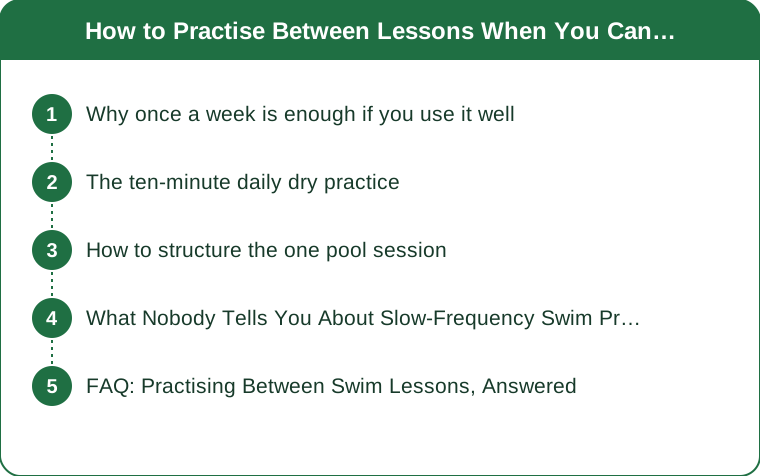
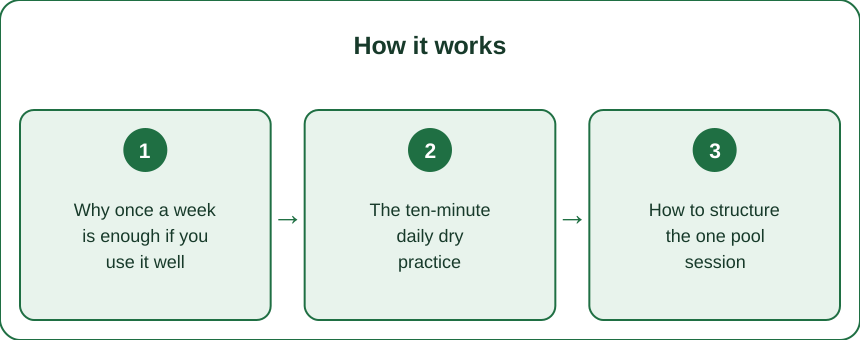
Why once a week is enough if you use it well
Motor learning depends on quality of repetition, not just quantity. A hundred lengths of a flawed stroke reinforces the flaw, which is why some adults swim weekly for a year with no change.
Adults learn differently from children, and mostly for good reasons. Adults understand instruction, can rehearse mentally, and can practise components separately - all of which children cannot do and all of which compensate for less water time.
The two things that actually limit adult beginners are breathing and body position, not strength or fitness. Both can be practised substantially on dry land, which is what makes once-a-week viable.
Consolidation happens between sessions, not during them. Motor skills settle in the days after practice, so a week’s gap is not wasted time provided something keeps the pattern active.
The failure mode of once-a-week is vagueness, not frequency. Arriving without a plan and swimming lengths until the hour is up produces very little, regardless of how often you do it.
A single focused session plus daily short dry practice reliably outperforms two or three unfocused swims. That is the trade this article is built on.
The ten-minute daily dry practice
Breathing rhythm in a sink or a bowl, two minutes. Face in the water, exhale steadily through the nose and mouth for three to four seconds, turn to breathe in through the mouth, repeat. This trains the single most common failure point for adult beginners.
The critical habit is exhaling underwater. Most struggling adults hold their breath, then try to exhale and inhale in the fraction of a second the mouth is clear - which is impossible. Continuous exhalation is the fix and it needs no pool.
Arm path rehearsal standing up, three minutes. Bend at the waist, rehearse the catch, the pull under the body, and the recovery slowly with each arm. Slow and correct beats fast and approximate.
Body position and core hold on the floor, two minutes. A simple prone hold with the head neutral and the hips lifted rehearses the horizontal alignment that keeps legs from sinking.
Ankle mobility, two minutes. Sitting with legs extended, point and circle the ankles. Stiff ankles are a genuine and very common limiter on adult kick efficiency, and this is entirely trainable on the sofa.
Mental rehearsal, one minute. Close your eyes and visualise a length of good swimming. Mental practice measurably improves motor performance, and it costs nothing but attention.
Ten minutes, six days a week, is 60 minutes of extra practice on the components that limit you - roughly equal to another pool session, without the pool.
How to structure the one pool session
Decide the single focus before you arrive. One thing - breathing timing, or body position, or catch - for the whole session. Two focuses become zero focuses within ten minutes.
First 15 minutes: drills on that one thing, no full swimming. This is when you are freshest and most capable of changing a pattern. Drills at the end of a session, when tired, mostly reinforce old habits.
Next 20 minutes: short repeats with rest. 4 to 8 lengths at a time with genuine rest between, holding the focus. Short repeats keep quality high; long continuous swims degrade into whatever you did before.
Last 10 minutes: easy swimming with no thinking. Let the nervous system integrate it. This is where the change starts to feel automatic rather than effortful.
Use equipment deliberately. A pull buoy isolates the arms so you can focus on catch; a kickboard isolates the legs and the breathing. Both remove variables, which is exactly what limited practice time needs.
Film one length on a phone from the poolside if the pool allows it. Adults respond enormously to seeing their own stroke, and one video often does more than a month of feel-based correction.
And write down one sentence afterwards. What you worked on and what changed. Next week’s session starts from that sentence rather than from scratch, which is most of what makes weekly practice cumulative.
What Nobody Tells You About Slow-Frequency Swim Practice
Progress arrives in steps, not slopes. Weeks of nothing followed by a sudden session where it clicks is the normal pattern for adult motor learning, and expecting a smooth curve is why people quit at week six.
The first ten minutes of each session will feel worse than the end of the last one. Re-entry after a week takes a few lengths. Judge the session by minute 20, not minute 2.
Fitness is rarely the limiter and often gets blamed. Being out of breath after a length is almost always a breathing pattern problem - specifically breath-holding - rather than a cardiovascular one.
Water confidence decays faster than technique. If a week feels like a long gap, it is usually the comfort that faded rather than the skill. Two minutes of floating and breathing at the start of each session rebuilds it quickly.
Goggles and cap problems eat more practice time than anything else. Fifteen minutes lost to leaking goggles is a quarter of a weekly session. Sort the equipment properly once and it stops costing you.
Cooler autumn pool halls change the warm-up. As the season turns, an unheated changing area and a cooler deck mean starting stiffer - add two minutes of easy movement before getting in.
And one honest constraint: some things genuinely need a coach’s eye. A single lesson every four to six weeks alongside your own practice is far more valuable than muddling through, if that fits the budget.
Ear discomfort, persistent shoulder pain, or breathing difficulty in the water should be raised with an instructor or a professional rather than trained through. This is general information, not medical advice.
FAQ: Practising Between Swim Lessons, Answered
Can I actually improve on one pool session a week?
Yes, if the session has a single focus and you do short daily dry practice. Quality of repetition drives motor learning more than volume, and the two main adult limiters - breathing and body position - are both partly trainable on land.
What is the most valuable thing to practise out of the water?
Exhaling continuously with your face in water, in a sink or bowl. Breath-holding is the single most common adult failure point, and it is fully fixable without a pool.
How should I structure a one-hour pool session?
Fifteen minutes of drills on one skill while fresh, twenty minutes of short repeats with rest holding that focus, and ten minutes of easy swimming with no thinking to let it integrate.
Why am I always out of breath after one length?
Almost always breath-holding rather than fitness. If you hold your breath underwater, you have to exhale and inhale in the fraction of a second your mouth is clear, which is not possible.
Should I swim lengths or do drills?
Drills first, while fresh, then short repeats. Long continuous swimming as a beginner mostly reinforces the pattern you already have, whatever that pattern is.
How long before I see progress?
Expect steps rather than a smooth slope - weeks of apparent stagnation then a session where something clicks. That is normal adult motor learning, and it is why week six is where most people quit.
Is it worth taking a lesson occasionally rather than weekly?
Often yes. One lesson every four to six weeks alongside structured self-practice gives you the coach’s eye where it matters most, at a fraction of the cost of weekly lessons.
TL;DR:
- One focused session beats three vague ones. Vagueness is the failure mode of once-a-week, not frequency.
- Ten minutes daily on dry land: breathing rhythm in a sink, arm-path rehearsal, prone body position, ankle mobility, one minute of mental rehearsal.
- Exhale continuously underwater. Breath-holding is the single most common adult limiter and needs no pool to fix.
- Structure the pool hour: 15 minutes of drills while fresh, 20 minutes of short repeats with rest, 10 minutes easy.
- One focus per session. Two focuses become zero within ten minutes.
- Film one length if the pool permits - adults respond enormously to seeing their own stroke.
- Write one sentence afterwards so next week starts from it rather than from scratch.
Progress comes in steps, not slopes. Week six is where most adults quit, and it is usually right before the step. Persistent ear or shoulder pain deserves a professional opinion - this is general information, not medical advice.
Keep Reading
This article is for general informational purposes only and is not medical advice. Always consult a qualified health professional for guidance specific to you.