Why Adults Sink When They Stop Kicking and What Floating Actually Takes
Quick Answer: Floating is not about effort or courage — it is about density and geometry. Your chest contains air-filled lungs and floats; your legs are dense muscle and bone and sink. That mismatch makes your body rotate feet-down the moment you stop moving, which feels like sinking and is actually just tilting. Most lean adults cannot float horizontally and motionless, and do not need to: real floating is managing head position, breath, and body angle — and every bit of it is learnable in a couple of sessions.
Here is the physics, and the progression adult teachers actually use.

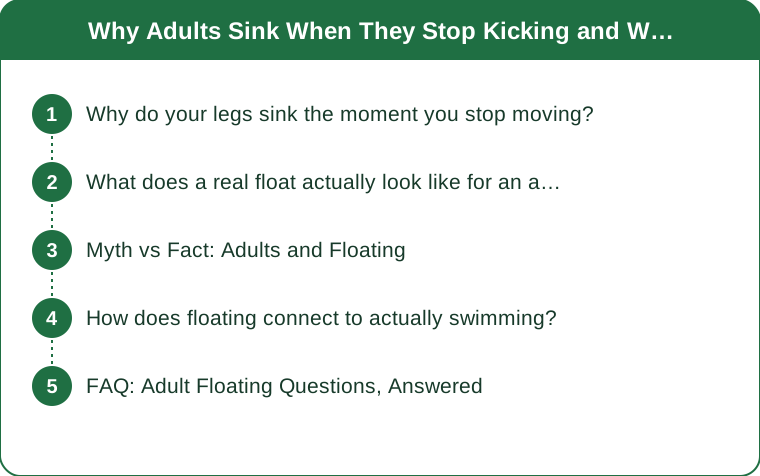
Why do your legs sink the moment you stop moving?
Because your body is two different boats welded together.
Buoyancy is a density contest. Anything denser than water sinks; anything less dense floats. Your body is not one material — it is a mix. Lungs full of air make the chest genuinely buoyant. Muscle and bone are denser than water, and legs are mostly muscle and bone.
So your body has a float point and a sink point in different places. The centre of buoyancy — where the floatiness acts — sits in your chest. The centre of mass — where gravity acts — sits lower, around the hips. Water pushes the chest up while gravity pulls the hips down, and the pair form a lever that rotates you feet-downward until you hang more or less vertically. The rotation is not you failing to float. It is your specific body finding its actual balance point.
Lean, muscular, and long-legged bodies rotate hardest. Fat is less dense than water and distributed everywhere; muscle is denser and concentrated in the legs. A lean adult with strong legs is built to hang vertically in water — many competitive swimmers cannot do a motionless horizontal float either, which surprises every adult beginner who hears it.
Panic then adds the only real sinking. Fear curls the body, lifts the head, and empties the lungs in short gasps — removing air from your one flotation chamber exactly when you want it fullest. The physics were fine; the posture change is what puts a face underwater.
What does a real float actually look like for an adult?
Tilted, breathing, and quiet — not a horizontal photograph.
Accept the angle your body chooses. For most adults a relaxed back float settles with hips and legs noticeably lower than the chest. That tilted position is a completed, successful float. Chasing perfectly horizontal legs by thrashing them upward is what exhausts beginners and teaches nothing.
The head is the steering wheel. In a back float, ears in the water and eyes to the sky. Lifting the head even two inches drives the hips down a foot — it is the highest-leverage mistake in all of floating. Where the head goes, the body follows a moment later.
Breath is the buoyancy dial. Full lungs float you; empty lungs sink you. The adult skill is the float breath: keep the lungs mostly full, exchange air with quick exhale-inhale swaps rather than long complete empties, and feel yourself rise slightly with each inhale. Bobbing gently with the breath is the float working, not failing.
The progression that works:
Stage one — supported back float. Shallow end, a teacher’s hands or a noodle under the shoulders, and the only job is ears-in, eyes-up, slow breath. This stage is about the nervous system, not technique.
Stage two — starfish with a big surface. Arms wide, legs apart. Spreading mass wide slows every rotation, like a tightrope walker’s pole.
Stage three — the vertical float. Let the legs hang, arms sculling lightly, face clear. This one matters most: it is the resting position for deep water, and discovering that hanging vertically is stable and calm removes most of the fear that caused the sinking.

Myth vs Fact: Adults and Floating
Myth: Everyone can float if they just relax. Fact: Relaxation prevents the panic-sink, but body composition decides the resting angle. Plenty of calm, lean adults float steeply tilted or nearly vertical. Relax is half the instruction; the other half is stop expecting horizontal.
Myth: If you cannot float, you cannot learn to swim. Fact: Swimming is dynamic — gentle forward motion lifts the legs the way airflow lifts a wing. Many adults swim comfortably for life without ever holding a motionless horizontal float. Floating skill and swimming skill overlap far less than beginners fear.
Myth: Hold a deep breath to stay up. Fact: A rigid held breath raises tension and ends in a gasping empty-lung moment — the exact sinking state. Mostly-full lungs with quick exchanges beat one heroic breath every time.
Myth: Muscular people sink because something is wrong with them. Fact: Muscle is simply denser than water. Sinking legs are a body composition fact, not a swimming verdict — and the fix is technique and propulsion, not more floating practice.
Myth: Fear of water means you are not a water person. Fact: Adult water fear is common, often decades old, and responds remarkably well to graded practice with support. Most adult-lesson teachers consider the fearful beginner their standard student, not their exception.
How does floating connect to actually swimming?
It removes the panic, and then motion solves the leg problem for you.
Swimming rescues the float. The moment you move forward, water flows under the body and lifts the legs — pressure from motion does what no amount of stillness could. This is why sinking-leg adults often feel more stable swimming slowly than floating still, and why teachers get nervous beginners moving early rather than drilling stillness for weeks.
The vertical float is the real safety skill. Deep-water comfort is not about staying horizontal — it is about knowing that if you stop, you hang, you breathe, and nothing bad happens. Once that is in the body, the fear tax on every other skill drops sharply, and progress speeds up across the board.
Drills that bridge float to stroke: push-and-glide from the wall, face down, arms ahead — feel the legs ride up with speed and settle as you slow. Add a gentle flutter the moment they settle. Then the same on the back. Weeks, not months, for most adults attending once or twice a week.
What to wear matters more than adults expect. A well-fitting one-piece that stays put lets you focus; anything you tug at steals attention from a nervous system that needs all of it. Goggles that seal stop the eye-sting flinch that breaks head position.
And a late-summer practicality: outdoor pools across the country close or cut hours after Labor Day, and adult-lesson blocks at indoor pools fill in September as everyone has the same idea. If floating finally clicked this summer, book the fall indoor block now rather than letting the skill sit for eight months — the nervous-system gains fade far faster than the muscle memory does.
FAQ: Adult Floating Questions, Answered
How long does it take an adult to learn to float?
With support and decent instruction, most adults get a calm supported back float in one or two sessions and an independent one inside a few weeks. The vertical resting float often comes faster than the horizontal one. Fear history adds time; it does not change the outcome.
Why can my friend float flat when I cannot?
Body composition. More body fat and shorter legs float flatter; lean, muscular, long-legged bodies tilt steeply. Neither body is doing floating better — they have different resting angles, and both can swim equally well.
Should I practise floating in deep or shallow water?
Learn supported floats where you can stand, because the ability to simply put feet down keeps the nervous system quiet. Move the skills to deep water with a teacher or a flotation aid once they are boring in the shallow end — boring is the readiness signal.
Is it normal to get water in my ears on a back float?
Yes — ears-in is the correct head position, and water in the outer ear is harmless for most people. Tilt and tug the ear after the session to drain it. If you are prone to swimmer’s ear, simple ear drops after swimming help.
TL;DR:
- Your chest floats and your legs sink, so your body rotates toward vertical when you stop moving — that is physics finding balance, not you failing.
- A real adult float is often tilted; the controls are head position (ears in, eyes up), mostly-full lungs with quick breath exchanges, and a wide starfish shape.
- The vertical resting float is the true deep-water safety skill, and forward motion lifts sinking legs automatically — swimming rescues the float, not the reverse.
- Book fall indoor lessons before the September rush; nervous-system gains fade fastest when practice stops.
Next session, try the vertical float where the water is just over your shoulders. Discovering that you simply hang there changes everything above it.
Keep Reading
This article is for general informational purposes only and is not medical advice. Always consult a qualified health professional for guidance specific to you.