Why Learning Backstroke First Fixes Freestyle Breathing
Quick Answer: Backstroke keeps your face out of the water, which means you can practise horizontal body position, a relaxed exhale, and continuous rotation without ever managing the breath-holding reflex at the same time. Most adult freestyle breathing problems are actually body-position and exhale problems, and backstroke isolates both. Two or three weeks of backstroke work commonly does more for freestyle breathing than months of drilling freestyle.
You have been working on your breathing for weeks. The suggestion to go and swim a stroke you did not ask about sounds like a detour. It is usually the shortcut.

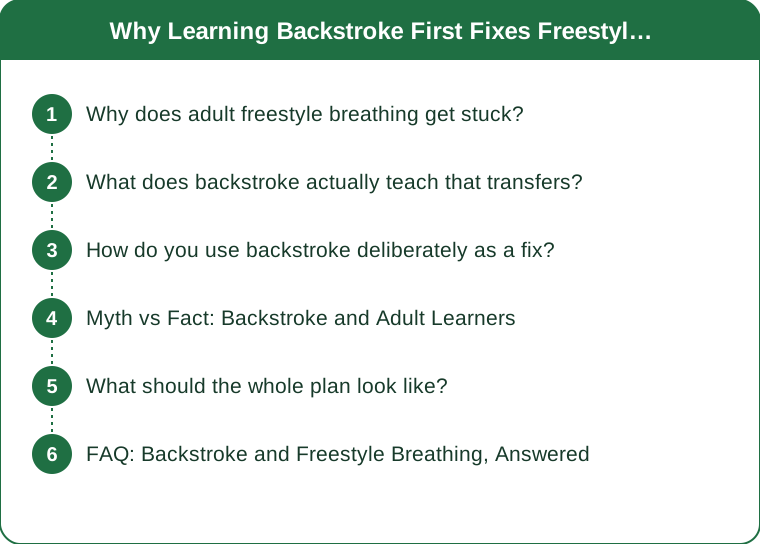
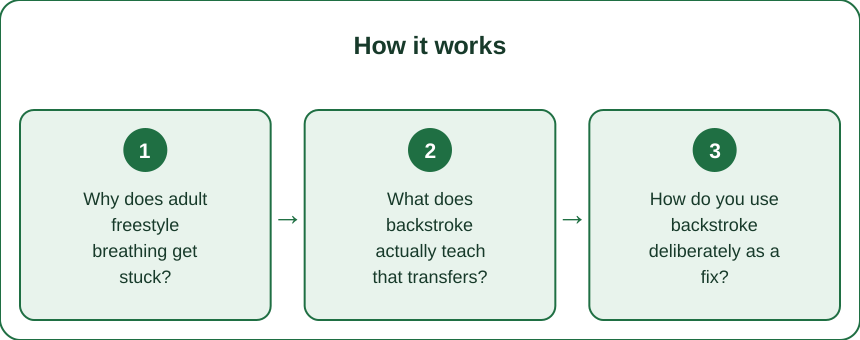
Why does adult freestyle breathing get stuck?
Because it asks you to solve four problems simultaneously, and you can only think about one.
Freestyle breathing requires you to: maintain a horizontal body line, keep rotating through the long axis, exhale continuously underwater, and time an inhale into a window of under a second. Any one of those is manageable. All four at once, while your face is submerged and your nervous system is objecting, is not.
So people default to the one that feels most urgent — getting air — and that is what produces the classic adult pattern: lifting the head instead of rotating, holding the breath instead of exhaling, and then gasping into a window that is now too short because the head lift sank the hips.
Each of those failures causes the next. Lifting the head drops the legs, which increases drag, which makes you work harder, which increases your air hunger, which makes you lift the head sooner and further. It is a self-reinforcing loop and it is why people plateau for months.
The underlying issue is almost never lung capacity. It is breath-holding, which raises carbon dioxide, which produces the urgent feeling that you need air — when what you actually need is to get rid of air you are still holding.
And here is the part that makes it hard to fix in freestyle: you cannot practise a calm continuous exhale while you are anxious about the next inhale. The anxiety and the skill occupy the same attention, and the anxiety wins.
Which is exactly the problem backstroke removes.
What does backstroke actually teach that transfers?
Four things, and three of them are the freestyle problem.
A horizontal body line, learned without breath pressure. Backstroke demands the same thing freestyle does: hips up, head neutral, body long and flat near the surface. Because your face is out of the water, you can spend a whole length attending purely to whether your hips are sinking. This is the single most valuable transfer, because a horizontal body line is what creates a breathing window in freestyle in the first place.
Long-axis rotation. Backstroke and freestyle rotate around the same axis in the same way — one shoulder drops as the other rises, driven from the hips. Backstroke lets you feel that rotation and exaggerate it with no penalty. Freestyle breathing is fundamentally a rotation, not a head movement, and most adults have never felt the rotation clearly enough to use it.
Continuous relaxed breathing while swimming. In backstroke you simply breathe. What that builds is the habit of breathing rhythmically in time with the stroke, rather than in a panic between held breaths. It also lets your body learn that swimming and calm breathing coexist, which is a genuine nervous-system adaptation rather than a technique one.
A steady kick from the hips. Backstroke exposes a knee-driven kick immediately, because a bent-knee kick pushes you backward and you can feel it. Adults who fix their kick in backstroke usually find their freestyle legs stop sinking.
What it does not teach is the inhale timing itself, and that is fine. Timing is the easy part once the other three are in place — it is only hard when you are also fighting a sinking body and a held breath.
How do you use backstroke deliberately as a fix?
A short, specific progression, not just swimming laps of it.
Week one: floating and body line.
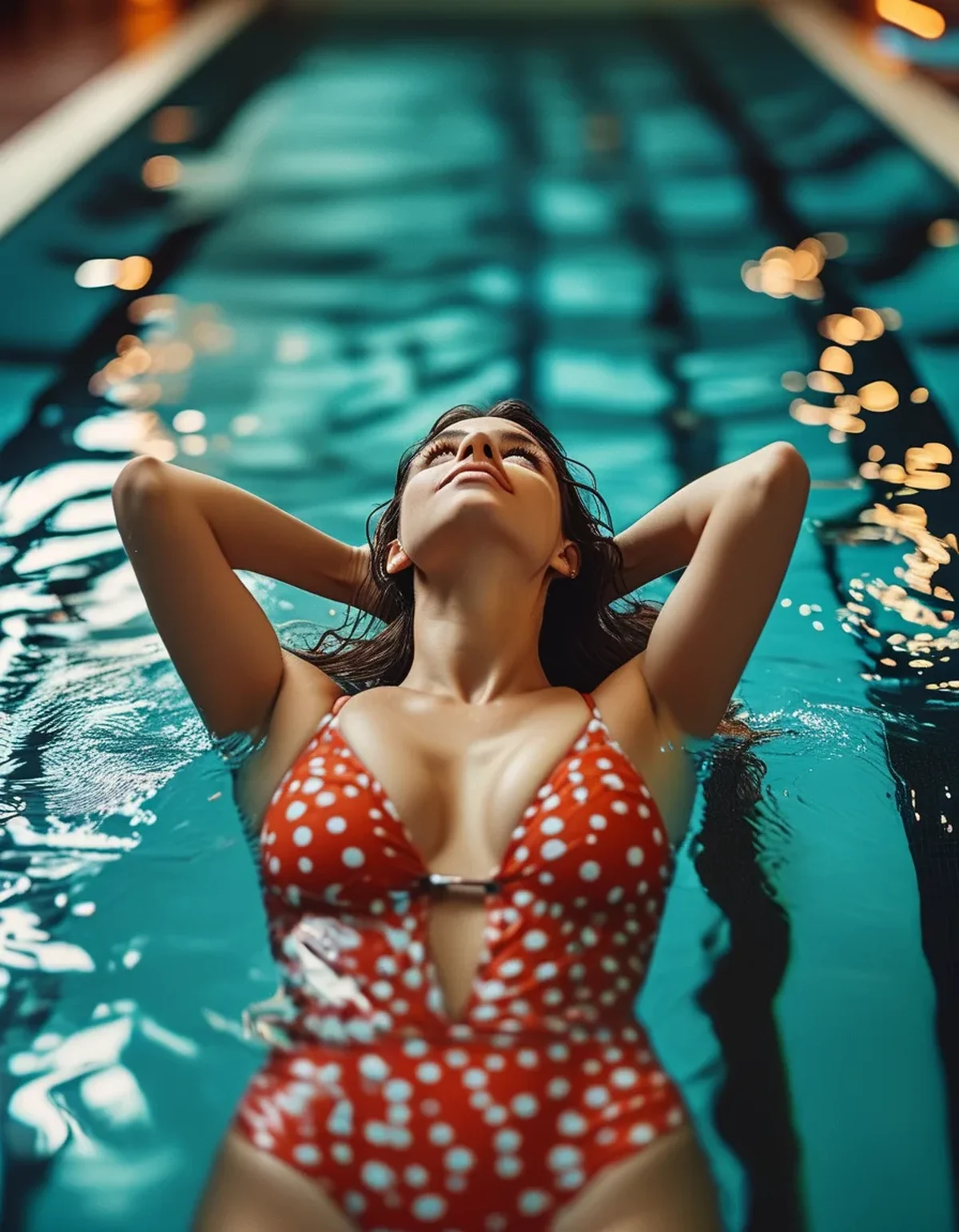
- Back float, arms by your sides, in shallow water where you can stand up. Aim for 30 seconds of stillness. Look straight up, not toward your feet — looking down at your feet drops the hips instantly.
- Back float with a gentle flutter kick, travelling slowly. Focus only on hips staying up near the surface.
- Breathe normally throughout, in and out, out loud if it helps. The point is to notice that you can.
Week two: rotation.
- Kick on your back with one arm extended overhead, body rotated slightly toward that arm. Hold 6 kicks, then switch. This is the same body position freestyle wants.
- Add a slow single-arm backstroke, pausing at each recovery to feel the shoulder rise and hip drop.
- Full backstroke, slowly, counting your breath in time with the arms — one breath per arm cycle.
Week three: transferring it.
- Alternate 25 backstroke, 25 freestyle, keeping the same body-line feeling in both. The comparison is the teaching tool.
- Freestyle kick on your side, one arm extended, breathing freely — this is the bridge drill and it feels almost identical to week two’s rotation drill with the face turned.
- Then freestyle with breathing, thinking only about exhaling continuously and letting the rotation bring your mouth to air.
Two things to hold onto throughout: exhale in the water, always, and keep one ear in the water when you breathe in freestyle. If both ears come out, you lifted rather than rotated.
And the water in the nose problem, which is the main objection: it happens because you stop exhaling. A slow continuous breath out through the nose keeps water out, and a nose clip is a perfectly reasonable tool for the first few weeks while you learn that.
Myth vs Fact: Backstroke and Adult Learners
Myth: Backstroke is harder because you cannot see where you are going. Fact: It is disorienting for about two sessions, then you learn to use the lane rope and the ceiling. The tradeoff is that your airway is permanently available, which for a nervous adult swimmer is worth far more than forward vision. Count strokes to know where the wall is, and swim in the middle of an empty lane while you are learning.
Myth: Learning a second stroke divides your attention and slows progress. Fact: For most adults it does the opposite, because the two strokes share body position and rotation and one of them lets you learn those without breath stress. What genuinely divides attention is trying to fix four things at once in freestyle, which is what most people are doing.
Myth: Backstroke wrecks your shoulders. Fact: Poor backstroke technique — a wide, flat arm recovery and no rotation — can be hard on shoulders, exactly as poor freestyle can. Rotating properly and entering the hand little-finger-first with the arm close to the shoulder line puts the joint in a much better position. If you have a history of shoulder trouble, get a coach to look at it rather than guessing.
Myth: You should master freestyle before touching anything else. Fact: This is the received wisdom and it is backwards for adults specifically. Children learn freestyle breathing easily because they have no fear response to manage; adults do, and removing it from the equation while the mechanics are built is the more efficient order.
Myth: If you can float on your back, you have got the body-position part. Fact: Floating still and holding a line while moving are different skills. Movement introduces drag, and drag pulls the hips down. Kicking slowly on your back for a full length while keeping the hips at the surface is the actual test, and it is harder than it sounds.
What should the whole plan look like?
Three to four weeks, two or three sessions a week, with freestyle kept in the mix rather than abandoned.
Session structure, about 30 minutes:
- 5 minutes: easy back float and back kick. Nervous-system warm-up as much as physical.
- 10 minutes: the week’s backstroke drill from the progression above, with rest whenever you want it. Rest is not failure here — you are learning calm, and swimming to exhaustion teaches the opposite.
- 10 minutes: freestyle, short distances. 25s or even 12s, with the single instruction to exhale continuously. Do not try to fix everything.
- 5 minutes: easy anything. Finish comfortable.
Measure the right thing. Not distance and not speed. Count how many strokes you take per 25 in freestyle, and note whether your breathing felt calm or urgent. Stroke count falling means your body position improved. Calm replacing urgent means the exhale habit is forming. Those two numbers move well before your distance does, which matters because otherwise it feels like nothing is happening.
Expect the timeline to be uneven. Most adults get a noticeable change in the second or third week, often quite suddenly — the breathing stops feeling like an event and starts feeling like part of the stroke. Before that it can feel like no progress at all.
Get one lesson if you can. Twenty minutes of a coach watching your body line will short-cut weeks of guessing, and adult beginner lessons are widely available at most pools. If cost is the barrier, film yourself from the side with a phone in a waterproof pouch propped on the pool edge — you will see your hips in one viewing.
And a seasonal note: indoor pools get busier from September as outdoor swimming ends, so early morning and mid-afternoon lanes are much quieter than the after-work window — which matters more than usual when you are learning something that needs space and calm.
FAQ: Backstroke and Freestyle Breathing, Answered
How long before I see the freestyle improvement?
Most adults notice a change within two to three weeks of consistent work, and the change usually arrives as a step rather than a gradient — breathing stops being an interruption and becomes part of the rhythm. Body position often improves before breathing does, so a falling stroke count is the early signal.
What if I hate being on my back and feel like I am drowning?
That is common and it is worth respecting rather than pushing through. Start in shallow water where you can stand at any moment, hold the pool edge and lie back from there, and use a noodle under your shoulders for the first sessions. The goal for the first week is 30 relaxed seconds, not a length. If the water-in-the-nose sensation is the trigger, a nose clip removes it entirely and there is no reason not to use one.
Should I still practise freestyle while I do this?
Yes — keep short freestyle swims in every session, with one simple focus each time. What you are removing is the pressure to fix freestyle breathing by drilling freestyle breathing, not freestyle itself. Adult swimmers who drop it entirely tend to lose confidence in it. If any of this causes ear pain, dizziness, or chest tightness, stop and check in with a doctor before continuing; this is general information, not medical advice.
TL;DR:
- Freestyle breathing asks you to fix body line, rotation, exhale, and timing at once, and the air hunger wins every time
- Backstroke removes the breath-holding problem entirely, so you can build horizontal body position and long-axis rotation calmly
- The transfer is real because both strokes rotate the same way and want the same hips-up line
- Run a three-week progression — float, then rotation, then alternating 25s — and always exhale continuously in the water
- Track stroke count per 25 and whether breathing felt calm, because those move before distance does
The detour is the point. Take the breathing panic out of the equation, build the body position that creates a breathing window, and freestyle breathing turns out to have been a body-position problem the whole time.
Keep Reading
This article is for general informational purposes only and is not medical advice. Always consult a qualified health professional for guidance specific to you.