Why Outdoor Pool Lessons Progress Faster Than Indoor Ones for Adults
Quick Answer: Adult beginners are limited mostly by breathing anxiety and disorientation, and both are worsened by the sensory environment of a typical indoor pool. Outdoor pools have natural overhead light instead of glare, far less reverberation, warmer air, and more open space, all of which reduce the arousal that makes breath control difficult. The stroke does not change outdoors. The nervous system does.
If lessons have stalled indoors, the pool may be part of the reason.
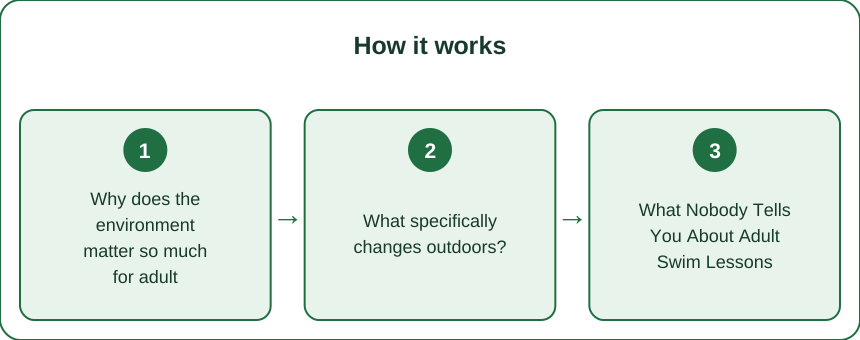
Why does the environment matter so much for adult learners?
Because the limiting factor for most adults is not strength or technique. It is the breathing response.
Children learn to swim quickly largely because they are less afraid. Adults arrive with a well-developed sense of risk, and the specific thing that triggers it — water on the face and restricted breathing — provokes an immediate physiological reaction.
What that reaction does: elevated heart rate, faster and shallower breathing, and increased muscle tension. Every one of those makes swimming harder. Tension makes you sink, because a rigid body position drops the hips. Faster breathing means you cannot hold air long enough for the stroke pattern. Elevated arousal narrows attention, so coaching instructions do not land.
Sensory environment feeds directly into arousal levels. An environment that feels calm reduces the baseline, and an environment that feels chaotic raises it, before anyone gets in the water.
Indoor pools have several specific issues:
Reverberation. Hard surfaces and water create long echo times, so noise builds and speech becomes hard to follow. You have to concentrate harder to hear your instructor, and shouted instruction reads as urgency.
Lighting and glare. Overhead artificial lighting reflects off the surface in ways that make the bottom hard to see, and losing visual reference is disorientating for a beginner.
Chemical smell. Chloramines accumulate in the air layer just above the water indoors, which is exactly the air you are breathing when swimming, and it irritates eyes and airways in some people.
Enclosure. A low ceiling, humid air, and a crowded space raise arousal for reasons that are hard to articulate and easy to feel.
Outdoors, most of these disappear.
What specifically changes outdoors?
Four things, each mapping onto a barrier adults actually hit.
Natural light from directly overhead. In daylight the bottom of the pool is clearly visible and the surface reflects less. Seeing the bottom is a large part of feeling safe, because it makes depth legible rather than abstract. Adults who panic about deep water often report the fear reduces when they can see the floor.
Sound dissipates instead of reverberating. With no ceiling, sound goes up and away. Instruction becomes intelligible at a conversational volume, which changes the emotional tone of the whole lesson.
Air quality. Chloramines disperse into open air rather than collecting above the water, so the eye and airway irritation that indoor swimmers describe is largely absent.
Warm air on exit. A major, underrated one. Adults who are cold between drills lose the ability to relax, and shivering directly interferes with breath control. In late summer, getting out of the water is comfortable, so the pauses between attempts are recovery rather than endurance.
The practical effect is more time spent practising. Lesson quality is largely a function of how many attempts you make while calm, and outdoors, both terms improve.
One genuine downside worth naming: outdoor pools are seasonal and often busier, and the season is closing. Which makes right now the moment to use them rather than a general recommendation.
What Nobody Tells You About Adult Swim Lessons
Breathing is the whole skill. Adults think they need to learn arms and legs. Almost every adult plateau is a breathing problem wearing a technique costume. Fix exhalation and most of the stroke fixes itself.
You must exhale underwater, continuously. Holding your breath and trying to blow out and breathe in during a brief window is the single most common error, and it is why people feel breathless after 25 metres. Slow continuous bubbles, face down, is the drill worth more than any other.
Deep water is often easier than shallow. In shallow water the instinct is to reach for the bottom, which drops the hips and destroys body position. Adults frequently swim better in deep water once they trust it, which is a genuine surprise to them.
Progress is not linear and week six is the classic wall. Early gains come from confidence, and then you hit a technical ceiling and it feels like regression. It is not.
Goggle fit matters more than goggle price. A leaking goggle raises anxiety continuously, and adults tolerate it far longer than they should. Press them onto dry eye sockets without the strap — they should hold briefly by suction.
Being cold makes you a worse swimmer immediately. Not eventually. Shivering and muscle tension are incompatible with the relaxed position swimming requires.
Group lessons include long waits, and waiting cold and anxious undoes the previous attempt. This is the strongest argument for a few private lessons early on.
How do you use the rest of the outdoor season?
Deliberately, because most outdoor pools in the northern United States close within weeks.
Book intensively rather than weekly. Two or three sessions a week for the remaining outdoor weeks will produce more progress than one a week for three months, because skills that depend on reduced anxiety consolidate through frequency.
Prioritise the water confidence work outdoors — floating, breath control, deep water comfort, and gliding. These are the skills the environment most helps with, and they are the foundation everything else sits on.
Save technical stroke refinement for indoors in autumn, when consistent lane conditions and a coach’s eye matter more than the setting.
Go early in the day. Quieter lanes, calmer water, and cooler air that is still comfortable in late August.
Plan the transition rather than stopping. The most common pattern in adult swimming is a strong outdoor summer followed by a full stop in September, and then starting over the following June. Book the indoor sessions before the outdoor pool closes, while the motivation is still there.
Expect indoor water to feel colder. Indoor pools are often kept cooler than a late summer outdoor pool, and the first indoor session after a warm summer usually feels like a step backwards. It is temperature, not skill.
Bring what makes the pauses comfortable — a proper towel, something warm for between drills, and flip flops. Small comforts protect the calm state that the learning depends on.
If you have a medical condition affected by exertion or immersion, or any history of seizures or cardiac problems, talk to your doctor before starting lessons, and tell your instructor. This is general guidance rather than medical advice.
FAQ: Adult Swim Lesson Questions, Answered
Is an outdoor pool really better for learning?
For confidence and breathing work, generally yes, because light, sound, and air quality all reduce anxiety. For fine stroke correction, a consistent indoor lane with a coach is usually better. Use each for what it does well.
Why do I feel out of breath after one length?
Almost always because you are holding your breath rather than exhaling continuously underwater. That leaves you with no time to inhale properly and a rising urge to breathe. Practise slow bubbles face-down before anything else.
I panic in deep water. Is that fixable?
Yes, and it usually responds to graded exposure with an instructor rather than to technique work. Being able to see the bottom, which outdoor daylight allows, tends to help considerably during that process.
Should I keep going when the outdoor pool closes?
Book indoor sessions before it does. The most common reason adult swimmers lose progress is a seasonal stop, and the skills fade faster than people expect.
TL;DR:
- Adult swimming is limited by the breathing and anxiety response more than by strength or technique.
- Outdoor pools reduce that response through natural light, low reverberation, better air, and comfortable exits.
- Use the remaining outdoor weeks for confidence, floating, and breath control, and save fine stroke work for indoors.
- Book your autumn indoor sessions now, before the seasonal stop erases the summer’s progress.
Spend the first five minutes of your next lesson doing nothing but slow bubbles face-down. It is the drill that unlocks the rest.
Keep Reading
This article is for general informational purposes only and is not medical advice. Always consult a qualified health professional for guidance specific to you.