Why You Sink the Moment You Stop Kicking as an Adult Beginner
Quick Answer: If you sink when you stop kicking, your legs are hanging below your hips and your lungs are under-inflated. Buoyancy comes from air in your chest and from body position — pressing your chest down and exhaling slowly, rather than kicking harder, is what raises your legs.
You can cross the pool. It takes everything you have, your legs never stop, and the second you pause you go straight down like the deep end was waiting for you.
So you conclude you need stronger kicks. That conclusion is why week six feels exactly like week two.

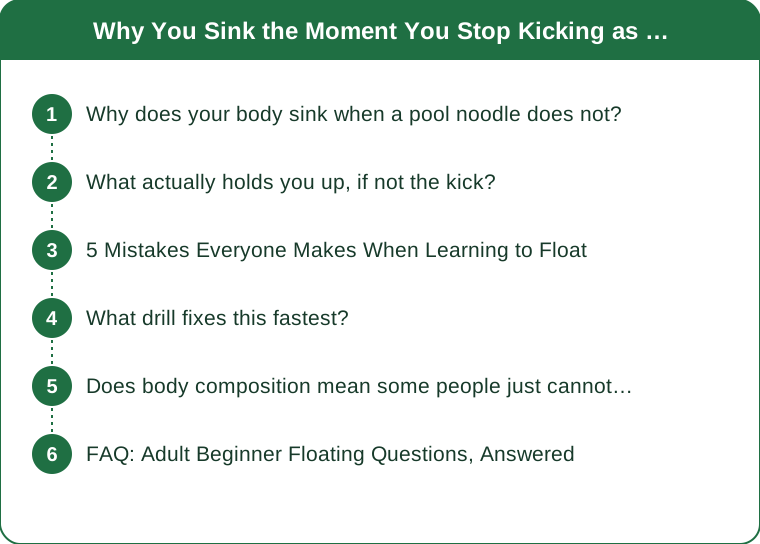
Why does your body sink when a pool noodle does not?
Human bodies are close to neutrally buoyant, but not uniformly. Fat is slightly less dense than water. Muscle and bone are denser than water. Air in your lungs is dramatically less dense.
That distribution creates a problem: your buoyancy is concentrated in your chest, while your densest tissue — leg bone and muscle — sits at the far end of your body.
So you do not sink evenly. You rotate. Your chest stays near the surface while your hips and legs swing down, until you are hanging vertically in the water with your face at the surface and your feet pointing at the bottom.
At that angle your body presents its full length to the water as drag. Every kick is now fighting to push a vertical column forward. That is why it feels like you are working three times as hard as the person gliding past you — you are.
What actually holds you up, if not the kick?
Two things: lung volume and the position of your center of buoyancy relative to your center of mass.
A full inhale adds roughly 4 to 6 liters of air to your chest, which is a meaningful amount of lift. Beginners under stress tend to breathe shallow and fast, holding maybe half that — and then exhale hard and completely, which is the moment they feel themselves drop.
The position piece is the lever you have most control over. Pressing your chest and upper sternum slightly down into the water rotates your body around its center like a seesaw — chest down, hips and legs up. Swim coaches call it pressing the buoy, and it works instantly.
Head position is part of the same lever. Looking forward lifts the head, which drops the hips. Looking straight down at the bottom, with your neck neutral and the waterline crossing the crown of your head, keeps the line flat.
5 Mistakes Everyone Makes When Learning to Float
1. Holding the breath. It feels like it should help, and it does briefly, but it builds CO2 and creates panic within 15 to 20 seconds. Slow, continuous exhalation into the water is what makes floating sustainable.
2. Lifting the head to check. Every glance forward drops the hips several inches. Trust the position and keep your eyes down.
3. Tensing the legs. Rigid, straight legs sink harder than relaxed ones. Soft knees and loose ankles let the legs ride higher.
4. Kicking from the knee. Bicycle-style kicking creates drag and does nearly nothing for propulsion. The kick starts at the hip, with a small, quick motion and a relaxed ankle.
5. Practicing floating only when tired. Most people attempt floats at the end of a lesson when they are breathing hard. Anxiety and elevated breathing rate make floating genuinely harder — practice it first, when calm.

What drill fixes this fastest?
The most efficient use of your next three lessons is not lap work. It is a progression that separates buoyancy from propulsion entirely.
Step 1 — Star float, 5 rounds. In shallow water, big inhale, face in, arms and legs spread wide. Hold for 10 seconds while exhaling slowly through your nose. Wide limbs raise buoyancy and reduce rotation, so this succeeds even for dense-legged swimmers.
Step 2 — Prone glide with press, 8 rounds. Push off the wall, arms extended, face down, and consciously press your chest down. Hold with zero kicking until you slow to a stop. Note where your legs are — most people watch them rise for the first time here.
Step 3 — Glide plus six kicks, 8 rounds. Same push-off, hold the glide for 3 seconds, then add six small kicks from the hip. This teaches that the kick is an addition to a floating body, not the thing preventing a sinking one.
Step 4 — Back float with slow exhale, 5 rounds. Ears in the water, hips up, gentle continuous breathing. This is the safety skill worth having regardless of stroke goals.
Twenty minutes of this beats an hour of exhausting laps, every session.
Does body composition mean some people just cannot float?
Buoyancy genuinely varies. Higher muscle mass and lower body fat make floating harder, which is why lean, muscular athletes are often the most frustrated adult beginners — they are strong everywhere except in the one quality this task rewards.
But very few people cannot float at all with full lungs and good position. What varies is the margin. A dense swimmer may float with only their face clearing the water, and needs better position and better breath timing to make it work. A more buoyant swimmer can be sloppy and still stay up.
Salt water helps meaningfully — the ocean is roughly 2.5 percent denser than fresh water, which is enough to be noticeable.
If you are on the dense end, do not chase a picture-perfect surface float. Chase a flat, low-drag body line instead. You do not need to float motionless to swim well; you need your legs to stop hanging.
FAQ: Adult Beginner Floating Questions, Answered
How long should it take to float comfortably?
Most adults get a functional prone glide within 3 to 5 focused sessions once they stop treating it as a strength problem. Relaxed back floating often takes longer because it involves more trust than technique.
Should I use a pull buoy between my legs?
Yes, temporarily. It artificially raises the hips so you can feel what a flat body line is like. Use it for a few laps per session, but always finish with unassisted glides so you are learning the position, not depending on the float.
Why do I float fine in the shallow end but sink in deep water?
Almost always anxiety changing your breathing. Faster, shallower breaths mean less average lung volume and more tension. The water did not change; your inhale did.
TL;DR:
- You sink because dense legs hang below a buoyant chest, rotating you toward vertical.
- Lung volume and body position — not kick strength — determine whether you stay up.
- Press the chest down, look at the bottom, exhale slowly and continuously.
- Practice glides and floats first in the session, when you are calm, not last when you are gasping.
The kick is not your flotation device. Your chest is. Once that lands, the plateau most adult beginners hit around week six usually resolves in a couple of sessions — and swimming stops feeling like an argument with the water.
Keep Reading
This article is for general informational purposes only and is not medical advice. Always consult a qualified health professional for guidance specific to you.